NATIONAL INSTITUTIONAL RANKING FRAMEWORK
Let’s know in detail

About Us
National Institutional Ranking Framework (NIRF) is a ranking methodology released annually by the Ministry of Education, Government of India, to rank institutions of higher education in India. The framework was approved by the former Ministry of Human Resource Development (now the Ministry of Education) and launched by the Minister on 29 September 2015.
Depending on their areas of operation, institutions have been ranked under 11 different categories – overall, university, colleges, engineering, management, pharmacy, law, medical, architecture, dental and research. The Framework uses several parameters for ranking purposes like resources, research, and stakeholder perception. These parameters have been grouped into five clusters and these clusters were assigned certain weights. These weights depend on the type of institution. About 3500 institutions voluntarily participated in the first round of rankings.
Ranking Parameters & Weightages:
Ranking Parameters & Weightages
Institutions are evaluated on five core parameter groups , each with assigned weightage:
Teaching, Learning & Resources (TLR)
Research & Professional Practice / Collaborative Performance (RP / RPC)
Graduation Outcomes (GO)
Perception (PR)
Outreach & Inclusivity (OI)
Weights vary by institution type. For engineering, management, pharmacy, architecture (Category A institutions):
- TLR – 30%
- RP – 30%
- GO – 15%
- OI – 15%
- PR – 10%

For overall rankings and colleges:
TLR – 30% (40% for colleges)
Research-related metrics – around 30% (≈15% for colleges)
GO – 20% (25% for colleges)
OI & PR – 10% each

Why it is Important to know about NIRF?
- Guides students in college selection
- Ensures transparency in quality
- Benchmarks academic performance
- Supports informed parent decisions
- Helps recruiters find talent
- Drives institutional improvement
- Promotes healthy competition
- Assists government in evaluation
- Boosts global recognition
NIRF RANKINF PORTAL
Stay updated for your benefit
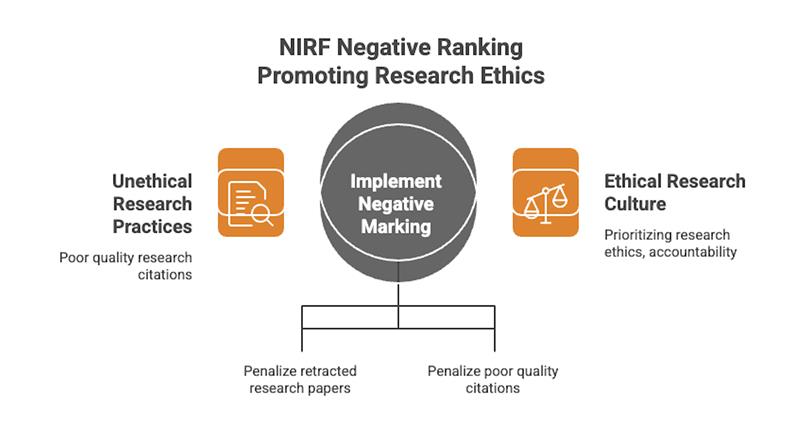
NIRF (National Institutional Ranking Framework) is set to introduce negative marking for institutions in cases of retracted research papers, citations of tainted research, and other poor-quality practices. For the first time, penalties will be formally included in the ranking system methodology to address research malpractice and misrepresentation of data.
Draft guidelines are being prepared, and the negative marking system will be announced soon. This change is aimed at strengthening credibility, promoting accountability in research, and ensuring that institutes with questionable practices do not unfairly climb the ranking ladder. The planned move has followed legal and public challenges regarding ranking transparency and data verification, and is expected to make the NIRF rankings a more accurate and trusted barometer for students, recruiters, and policymaker